Back to Top 5 Stress Herbs overview
Explore ashwagandha: how it works, proven benefits, dosage, types of extracts, safety tips, and easy ways to use it for stress and sleep in 2026.
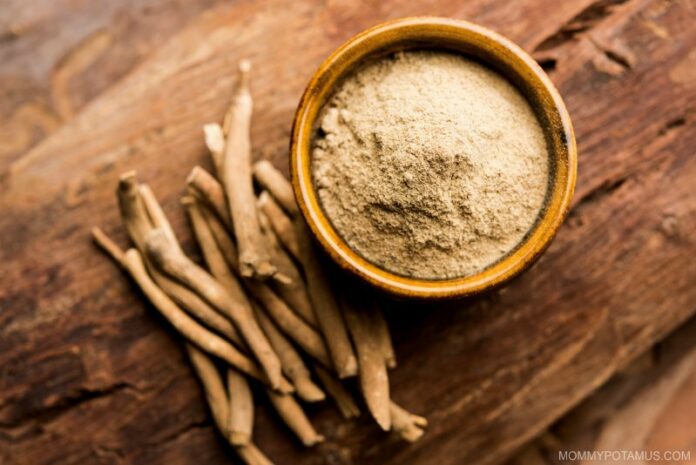
Table of Contents
1. Why a Deep Dive on Ashwagandha?
If you’ve looked into herbs for stress, you’ve probably seen ashwagandha. It appears in stress blends, sleep gummies, focus capsules, and pre-workouts. You may notice claims ranging from help with anxiety and sleep to boosting hormones and muscle growth.
This guide focuses on ashwagandha itself:
- what it actually is,
- what the science says it can help with,
- how it seems to work in the brain and body,
- which types of extracts and doses are used in studies,
- and, importantly, who should be careful or avoid it.
Use this as a reference if you’re thinking about adding ashwagandha to your stress or sleep routine.
2. Ashwagandha Profile: What It Is & Where It Comes From
Botanical basics
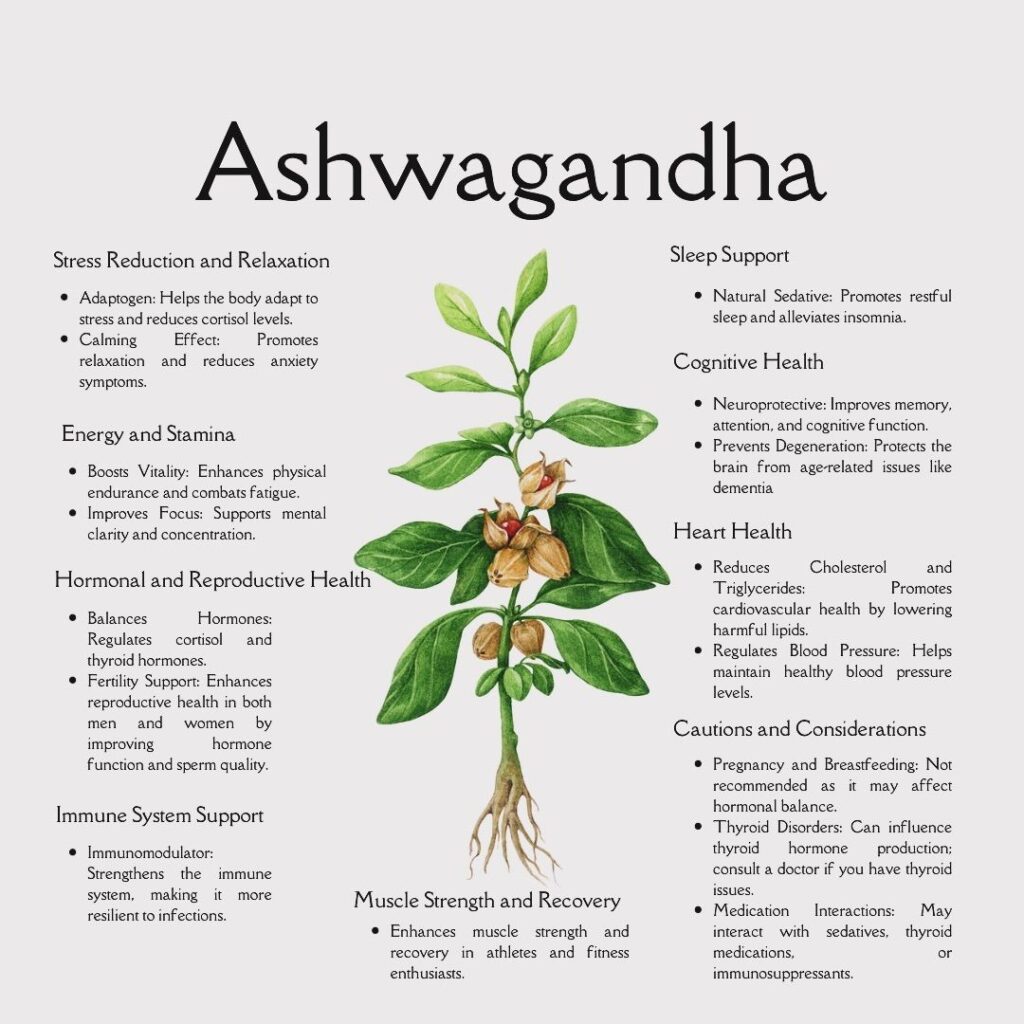
Ashwagandha (Withania somnifera) is a small shrub in the nightshade family (same family as tomatoes and peppers). It has:
- Pale green flowers and small orange‑red berries
- Thick, fleshy roots, which are the main part used for medicine.
- A natural habitat in dry regions of India, the Middle East, and parts of Africa

In Ayurveda, which is traditional Indian medicine, ashwagandha is considered a rasayana—a tonic meant to build resilience, strength, and longevity. It’s sometimes called “Indian ginseng” or “winter cherry,” but it isn’t actually related to true ginseng.
Taste and energetic profile
- Taste: slightly bitter and earthy, with a horse-like smell in strong preparations. “Ashwa” in Sanskrit means horse.
- In Ayurvedic terms, ashwagandha is often described as grounding, warming, and nourishing, especially for people who feel tired, anxious, or ungrounded.
Modern label: an adaptogen
Today, herbalists and integrative medicine practitioners call ashwagandha an adaptogen. Adaptogens help the body handle stress and support balance in the nervous, hormonal, and immune systems.
For ashwagandha, this mainly means it can:
- Smoothing out exaggerated stress responses
- Supporting recovery from long‑term stress
- Helping the whole body become a bit more resilient https://pmc.ncbi.nlm.nih.gov/articles/PMC12680924/
3. Evidence-Based Benefits (What Ashwagandha Can Help With)
Ashwagandha has been tested in many human studies. Most are small or medium in size, but some reviews and meta-analyses have combined their results.
3.1 Stress & anxiety
Numerous randomized controlled trials and meta-analyses demonstrate that ashwagandha can:
- Lower perceived stress (scores on questionnaires like the Perceived Stress Scale)
- Reduce anxiety symptoms (e.g. Hamilton Anxiety Scale) https://pmc.ncbi.nlm.nih.gov/articles/PMC11800443/
- Lower morning cortisol levels, especially in people with high stress https://apcz.umk.pl/JEHS/article/view/55327
A 2024 meta‑analysis of 9 RCTs (558 participants) found that daily doses of 125–600 mg of ashwagandha extract for 30–90 days significantly reduced perceived stress, anxiety scores, and serum cortisol levels compared with placebo. https://www.sciencedirect.com/science/article/abs/pii/S1550830724001691
A 2025 review of supplementation concluded that doses between 250–500 mg/day (sometimes up to 600 mg) for 4–13 weeks consistently improved stress and anxiety outcomes and lowered morning cortisol. https://pmc.ncbi.nlm.nih.gov/articles/PMC11800443/
3.2 Sleep
Several trials and reviews report improvements in:
- Time needed to fall asleep
- Total sleep time
- Subjective sleep quality – especially in people with stress‑related insomnia https://pmc.ncbi.nlm.nih.gov/articles/PMC12680924/
A 2024 review focused on sleep found that ashwagandha improved sleep onset, duration, and overall quality, while at the same time reducing stress and anxiety, likely through effects on the HPA axis and cortisol regulation. https://apcz.umk.pl/JEHS/article/view/55327
3.3 Other areas (where evidence is emerging, not definitive)
- Cognitive function & focus: Some studies suggest better attention and information processing in stressed adults. https://ijrpp.com/ijrpp/article/view/628
- Physical performance & recovery: Small trials in athletes and physically active adults show potential improvements in strength, VO2 max, and recovery markers. https://ijrpp.com/ijrpp/article/view/628
- Hormones (testosterone, thyroid): A few studies suggest increases in testosterone in certain male populations and changes in thyroid hormones. But here, the data are mixed, and there are also case reports of thyroid overactivity, so this is not a simple “benefit” category. https://www.aaem.pl/pdf-213417-132996?filename=Clinical+evidence+for+the.pdf
The most clearly supported benefits are:
stress, anxiety, and sleep, with possible bonus effects on cognition and performance.
4. How Ashwagandha Works in Body & Brain
The full biochemistry is complex, but here’s a simple way to picture it:
- Your stress system is like a thermostat (the HPA axis).
- Your brain also has a gas pedal (excitatory signals like glutamate) and a brake pedal (calming signals like GABA).
- Chronic stress can turn the thermostat up too high, keep the gas pedal pressed, and inflame the system.
Ashwagandha seems to help by gently lowering the stress response, calming the brain, and reducing background inflammation.
4.1 Calming the stress thermostat (HPA axis & cortisol)
The HPA axis (hypothalamus–pituitary–adrenal axis) controls how much cortisol is released in response to stress.
Preclinical and clinical work shows that ashwagandha:
- Reduces excessive stress‑induced cortisol surges
- Supports more normal cortisol patterns over the day https://pmc.ncbi.nlm.nih.gov/articles/PMC12680924/
- Acts on the hypothalamus and pituitary to tune CRH and ACTH, helping the feedback loop reset https://www.aaem.pl/pdf-213417-132996?filename=Clinical+evidence+for+the.pdf
Put simply, instead of overreacting to every minor stress, your body learns to respond more balanced.
4.2 Supporting the brain’s “brake pedal” (GABA & other transmitters)
GABA is the main calming neurotransmitter. It helps slow down overactive circuits, especially in regions linked to fear, worry, and overthinking.
Research suggests that ashwagandha:
- Has GABA‑mimicking activity – certain withanolides interact with GABA_A receptors and can increase chloride influx, similar (but milder) to how some anxiety medications work https://www.aaem.pl/pdf-213417-132996?filename=Clinical+evidence+for+the.pdf
- Helps normalize levels of GABA, serotonin, and dopamine that get disrupted by chronic stress in animal models https://ijrpp.com/ijrpp/article/view/628
So, in practical terms, ashwagandha seems to help calm the brain without making you overly drowsy.
4.3 Reducing “background noise” (inflammation & oxidative stress)
Chronic stress often comes with low‑grade inflammation and oxidative stress in the brain and body.
Withanolides and related compounds in ashwagandha:
- Down‑regulate inflammatory signals like NF‑κB and pro‑inflammatory cytokines
- Activate antioxidant pathways such as Nrf2, increasing the body’s own antioxidant defenseshttps://pmc.ncbi.nlm.nih.gov/articles/PMC12680924/
This may help protect brain cells from long-term stress and support better brain function over time.
5. Forms & Extracts: Powders, KSM‑66, Sensoril & More
Not all ashwagandha supplements are the same. Three main things vary:
- Which part of the plant (root only vs root + leaf)
- Extraction method (water, alcohol, or both)
- Standardization (how many withanolides per dose)
5.1 Common types you’ll see on labels
- Plain root powder
- Typically just dried and ground root.
- This is a very traditional form, but it isn’t standardized, so the exact withanolide content is unknown.
- Standardized root extracts
- Extracted and standardized to a specific percentage of withanolides (often ~2.5–5%).
- This type is used in many clinical trials and offers more predictable results.
- KSM‑66® – full‑spectrum root extract, often around 5% withanolides, widely used in human studies on stress and performance.
- Sensoril® is made from both root and leaf, often with a higher withanolide percentage. Some people find it feels stronger or more sedating.
- Shoden® – high‑concentration extract; in one trial, 240 mg/day improved anxiety and cortisol. https://pubmed.ncbi.nlm.nih.gov/31517876/
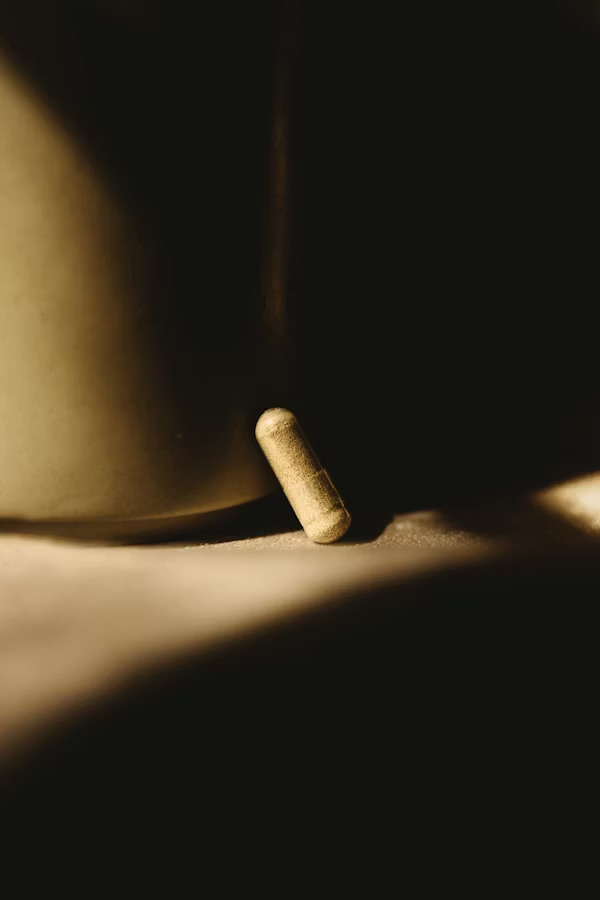
While most studies use ashwagandha in capsule form, you can also use the root in tea. Try our Energy & Resilience Tea Blend for a practical way to incorporate ashwagandha into your daily routine.
5.2 How to read a label (practically)
When you evaluate a product, look for:
- “Standardized to X% withanolides” – this means the active group of compounds is more controlled.
- Clear dose per capsule (e.g. “300 mg extract providing 15 mg withanolides”).
- Choose products that clearly state the plant part used, like “root extract,” and avoid proprietary blends that don’t list exact amounts.
- Quality signals: third‑party testing, contaminant testing, reputable brand.
6. Dosage: What Studies Actually Use (and How to Start)
6.1 Dosage ranges in research
Across RCTs and systematic reviews, typical doses are:
- 125–600 mg/day of standardized ashwagandha extract
- Over 4–13 weeks (most often 8–12 weeks) https://www.sciencedirect.com/science/article/pii/S0002934325003535
More detailed:
- Many stress/anxiety trials use 300–600 mg/day, often split into 1–2 doses. https://www.sciencedirect.com/science/article/abs/pii/S1550830724001691
- The NIH Office of Dietary Supplements notes that benefits often appear stronger at 500–600 mg/day and when taken for at least 8 weeks. https://ods.od.nih.gov/factsheets/Ashwagandha-HealthProfessional/
For plain root powder, traditional doses are often expressed in grams (e.g., 3–6 g/day), but because the withanolide content varies, it is difficult to compare directly with extracts.
6.2 A practical starting framework (for healthy adults)
This is not personal medical advice, just an example of how people often start. Always adapt to your health status and doctor’s guidance.
- If you are sensitive or new to herbs:
- Start around 150–300 mg/day of a standardized root extract with food.
- Take it once daily for 1–2 weeks to see how your body responds.
- If you tolerate it well and want to move toward typical study doses:
- Increase to 300–600 mg/day, split morning + evening OR once in the evening (depending on how it feels).
- Duration:
- Try a 6–8 week block, then reassess.
- There is good data for up to about 3 months of use. After that, long-term safety isn’t as well studied. https://ods.od.nih.gov/factsheets/Ashwagandha-HealthProfessional/
Always:
- Follow the dose on the specific product label.
- Consider lower doses if you are smaller, older, or more sensitive.
7. Safety: Common Side Effects, Real Risks & Who Should Avoid It
Most clinical trials report that standardized ashwagandha is well tolerated at typical dosages (300–600 mg/day) for up to 8–12 weeks. https://pmc.ncbi.nlm.nih.gov/articles/PMC11800443/
7.1 Common, usually mild side effects
In trials and reviews, people sometimes report:
- Mild digestive upset (nausea, soft stool, stomach discomfort)
- Drowsiness, feeling “too relaxed”, mild dizziness
- Occasional headache
These effects often happen about as often as with a placebo in many studies. https://pmc.ncbi.nlm.nih.gov/articles/PMC11800443/
7.2 Liver concerns (important but still rare)
Over the last few years, several case reports have described liver injury (hepatitis‑like symptoms, jaundice) in people taking ashwagandha supplements.
Key points:
- Cases typically appeared 2–12 weeks after starting ashwagandha, with doses between roughly 450–1350 mg/day.
- The pattern is usually cholestatic or mixed liver injury, sometimes with severe jaundice, but most patients recovered after stopping the supplement.
- Large safety reviews emphasize that these cases are rare compared to the huge number of users, and likely represent idiosyncratic reactions (unpredictable individual sensitivity). https://www.sciencedirect.com/science/article/abs/pii/S0378427425023410
What this means:
- If you have pre‑existing liver disease, what does this mean for you? Avoid ashwagandha unless your doctor is closely monitoring.
- If you start ashwagandha and develop unusual fatigue, dark urine, pale stools, yellowing of eyes/skin, itching, or strong nausea, stop immediately and contact a doctor.
7.3 Thyroid and hormonal effects
Ashwagandha can influence thyroid hormones and possibly sex hormones in some people:
- Some small studies report increases in T3 and T4 in hypothyroid patients, and possible mild effects in euthyroid people. https://www.aaem.pl/pdf-213417-132996?filename=Clinical+evidence+for+the.pdf
- There are at least a few case reports of thyrotoxicosis / painless thyroiditis after starting ashwagandha in previously healthy individuals and one person with hypothyroidism. https://pmc.ncbi.nlm.nih.gov/articles/PMC10981964/
So:
- People with hyperthyroidism or complex thyroid disease should be especially careful and only consider ashwagandha under medical supervision.
- If someone on thyroid medication starts ashwagandha, they should monitor labs with their doctor.
7.4 Groups that should generally avoid or only use under medical guidance
Based on current evidence and expert reviews:
- Pregnant or breastfeeding people – not enough safety data; some animal data raise concern.
- Children – pediatric data are limited; not recommended without specialist guidance.
- People with liver disease or a history of unexplained hepatitis.
- People with known hyperthyroidism or unstable thyroid disease.
- People with autoimmune diseases – not strictly contraindicated, but immunomodulatory effects mean closer supervision is wise.
- People on multiple psychotropic medications or strong sedatives (benzodiazepines, certain sleeping pills, some anti‑seizure drugs) – risk of additive sedation or interactions.
- Before surgery – often recommended to stop herbal supplements 1–2 weeks before operations.
A simple safety reminder for this article:
If you have a complex medical history, use prescription medication, or are pregnant, breastfeeding, or planning surgery, treat ashwagandha like a drug: only start it in dialogue with your doctor.
8. How to Choose a Good Ashwagandha Product
To help readers shop more wisely, you can include a short checklist.
8.1 Quality checklist
When evaluating a supplement, look for:
- Clear plant name and part: “Withania somnifera root extract” rather than vague “ashwagandha blend”.
- Standardization: e.g. “standardized to 2.5–5% withanolides”.
- Dose per capsule: e.g. “300 mg extract (providing X mg withanolides)”.
- Testing: mention of third‑party testing, heavy metal/microbe testing.
- Transparent ingredient list: minimal fillers, no unnecessary proprietary blends that hide real amounts.
9. How to Start: A Gentle, Step-by-Step Approach
You can give readers a simple protocol outline like this:
- Clarify your “why”.
- Stress at work/study? Sleep onset problems? Morning anxiety?
- This helps you see if ashwagandha is actually making a difference.
- Choose a standardized root extract.
- Aim for a 250–600 mg/day range, depending on sensitivity and label.
- Start low for 1–2 weeks.
- Example: 150–300 mg in the evening with food.
- Notice: sleep quality, morning energy, mood, and digestion.
- If you handle it well, you can try moving up to a typical study dose.
- Example: 300 mg in the morning + 300 mg in the evening (total 600 mg/day), or 300–500 mg once daily if that suits you better.
- Give it time.
- Realistic window: at least 6–8 weeks for full effects on stress and sleep.
- Check in with your body.
- Are you calmer? Sleeping better? Any side effects (GI issues, odd fatigue, weird symptoms)?
- If uncertain, take a 1–2 week break and see what changes.
- Avoid “mega‑dosing” or stacking with many strong herbs at once.
- Taking more isn’t always better. It can also make it harder to notice side effects or benefits.
10. A Simple Ashwagandha Ritual (to Make It More Than Just a Pill)
Ashwagandha fits especially well into an evening “down‑shift” ritual.
Evening ashwagandha + nervous system reset
- About 45–60 minutes before bed, take your ashwagandha dose with a small snack or warm drink.
- Make a cup of caffeine‑free tea (lemon balm, chamomile, or simply hot water with a slice of fresh ginger).
- Turn down overhead lights and switch to softer, warmer light if possible.
- For 5 minutes, practice slow, extended exhalation: breathe in for 4 counts, out for 6–8 counts, while feeling the weight of your body in the chair or bed.
- Write down three sentences:
- One thing you are grateful for.
- One thing you want to leave for “future you” to handle tomorrow.
- One way you can be kinder to your nervous system this week.
Doing a small, repeatable ritual like this helps your brain link ashwagandha with safety and rest, making its effects part of a bigger self-care routine.
For an alternative evening ritual, consider trying ashwagandha in herbal tea form combined with other calming herbs.
11. Bringing It All Together
Ashwagandha is one of the most researched adaptogenic herbs today. Clinical studies suggest it can:
- Reduce perceived stress and anxiety
- Lower morning cortisol
- Improve sleep onset and sleep quality
- Possibly support cognitive function and physical performance in stressed or active individuals
It appears to function through the following mechanisms:
- Calming an overreactive HPA axis (the stress thermostat)
- Gently strengthening GABA‑type calming signals in the brain
- Reducing inflammation and oxidative stress that builds up under chronic pressure
At the same time, responsible use means:
- Respecting dosage ranges that have actually been studied (roughly 250–600 mg/day of standardized extract, for 4–13 weeks).
- Being aware of rare but real risks like liver injury and thyroid overactivity, especially in vulnerable people.
- Avoid use in pregnancy, breastfeeding, serious liver or thyroid disease, and complex medical situations without professional guidance.
When you see ashwagandha as a helpful support—not a magic cure—it can be a useful part of a bigger plan that includes rest, healthy boundaries, movement, therapy, and other lifestyle or herbal supports.